Continuity Or Escalation? The Implications Of Netanyahu’s Electoral Resilience For The Middle East Crisis And The Lessons Of History


The Oasis Reporters
November 3, 2026



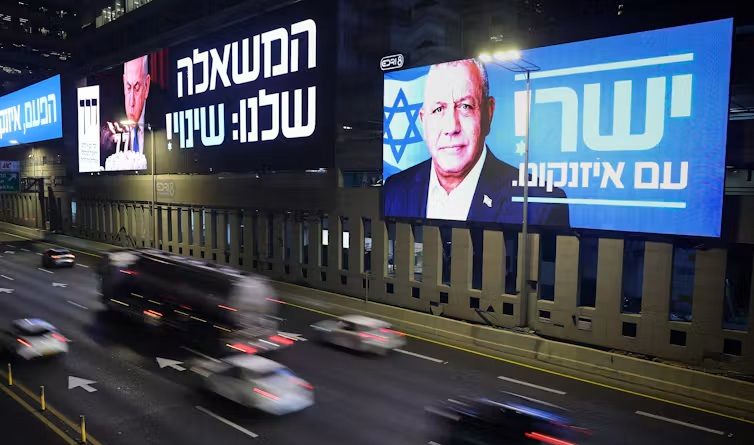
Last month, October 2026, the Israeli electorate went to the polls to elect a new leadership. As it turned out, the election was a test of endurance, not transformation.
Preliminary results showed neither bloc securing the required 61-seat majority, with Likud remaining the largest single party but without a clear governing mandate. Yet, the outcome reaffirms a deeper reality: the core policies of the Israeli state towards the Palestinians, Iran, and the regional order enjoy a cross-bloc consensus that transcends partisan competition.
On the Palestinian question, all major voting blocs appear to have converged on what may be termed a continuity consensus, signaling the unlikelihood of any significant shift in policy toward Palestine and the broader Middle East. Indeed, both Prime Minister Benjamin Netanyahu and his main rival, Gadi Eisenkot, have publicly opposed the establishment of an independent Palestinian state — a stance now shared by nearly all major Jewish-led parties.
Two scholarly interpretations have since emerged from this consensus. The continuity thesis argues that if Netanyahu succeeds in forming a government dependent on far-right partners, settlement expansion in the West Bank will continue apace and the space for a negotiated settlement will further shrink.
The restraint thesis, on the other hand, holds that even an opposition-led government would offer at best “a change in tone, not an immediate reversal” on Gaza, focusing on security management rather than statehood. The vortex point, therefore, is this: there is a continuity consensus in Israel on Palestine, and the election does not alter it.
On the question of Iran and the Northern Front, this is where electoral arithmetic risks escalation. The argument for escalation is fundamentally that Netanyahu’s political survival has become inseparable from active military engagement. A state of ongoing crisis more or less suppresses domestic demands for accountability over the October 7, 2023 failures, judicial reforms, and corruption trials.
Conversely, there is also a prevailing view in Arab capitals that Netanyahu’s hard line against Iran’s regional role aligns with their own security calculations, particularly concerns over Iranian hegemony.
A school of thought sympathetic to Netanyahu further argues that his personal relationship with President Trump is likely to make Israel more aggressive towards Iran, especially with American backing. It must be noted, however, that the same relationship could deepen Israel’s diplomatic isolation within the comity of nations and stall the prospects of Saudi normalization, which remains conditioned on restraint in Gaza and the West Bank.
My considered view, therefore, is that the implication of Netanyahu’s electoral resilience is not necessarily a new war, but prolonged strategic paralysis. The state retains executive discretion in security affairs but lacks the legislative mandate for either a decisive peace or a decisive victory. For historiography, this illustrates a classic civil-military paradox: deadlock inside produces escalation abroad, and the region pays the price.
THE LESSONS OF HISTORY
1. The Wartime Leader Paradox: History teaches that electorates in existential wars rarely change horses midstream, but they also rarely grant an absolute mandate.
For example, Winston Churchill won the war but lost the 1945 election.
Menachem Begin won the 1981 election by bombing the Osirak reactor.
Netanyahu follows the second model — what Israeli historians call the Mivtza Effect (Military Operation Effect). Since 2009, he has dominated six elections by positioning himself as Mr. Security. Security, therefore, remains the dominant electoral currency.
2. The Dilemma of Control Without Resolution: Security requires control, but control without political resolution creates permanent insecurity. Israel occupied the West Bank and Gaza in 1967 but never fully annexed them nor withdrew. Historian Avi Shlaim aptly calls this “the long occupation.” Every Israeli government since Levi Eshkol has faced the same dilemma: how to reconcile security imperatives with the political cost of indefinite occupation.
3. The Limits of Force: The ultimate historical lesson, from Thucydides to Clausewitz, is that no military victory resolves a legitimacy crisis. As long as about five million Palestinians live under occupation without citizenship and about two million Israelis live under persistent rocket threat, no election result is likely to resolve the fundamental challenge. History does not repeat itself, but as Mark Twain observed, it rhymes — and the rhyme of 2026 is one of continuity, not change.
Prof. Kenneth Azaigba, Department of History & Strategic Studies, Federal University Dutsin-Ma, Katsina State.


