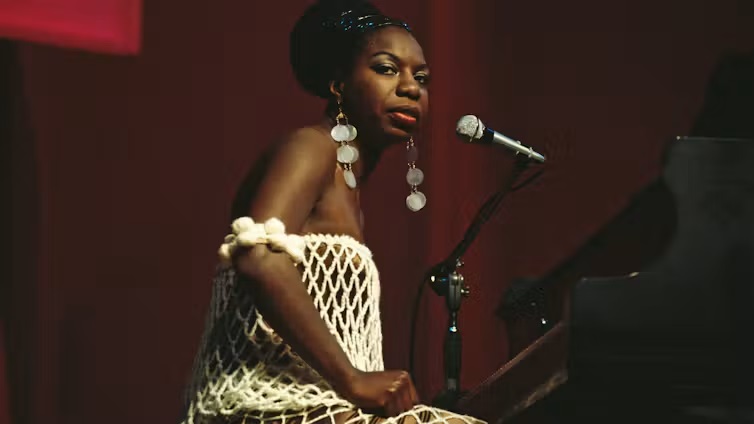
Nina Simone, Langston Hughes And Their Forgotten Creative Collaboration


The Oasis Reporters
October 1, 2026


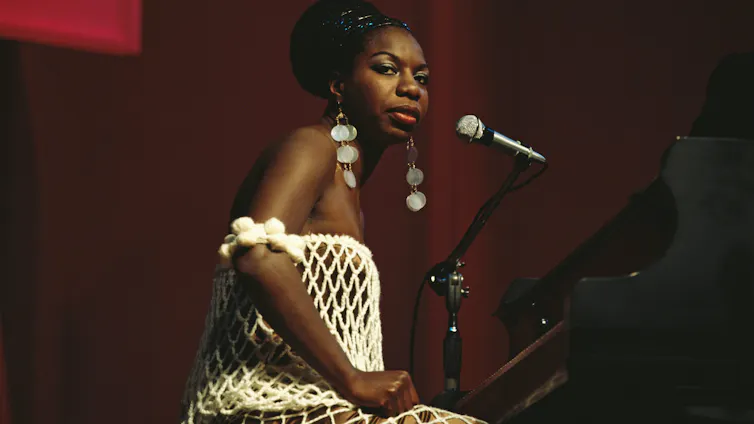
David Redfern/Redferns
Jason Miller, North Carolina State University
Many music fans know that Nina Simone’s 1965 hit “I Put a Spell on You” helped establish the 32-year-old singer as the “High Priestess of Soul.”
Few probably realize that it was Langston Hughes – the pioneering poet and face of the Harlem Renaissance – who had encouraged Simone to record it.
As a Langston Hughes scholar, I’ve spent the past six years documenting Hughes’ largely overlooked friendship with Simone. I explore the creative bond they shared in my newest book, “Don’t Let Me Be Misunderstood: Nina Simone, Langston Hughes, and the Birth of Black Power,” which details how the two supported and inspired each other.
The seeds of this relationship were planted in 1949, when Hughes delivered a lecture featuring his own poetry at Simone’s high school in Asheville, North Carolina. Simone – then known by her birth name, Eunice Waymon – was just 16 years old.
As part of the programming, Simone played the piano. Hughes was impressed. Even though she was just a teenager, Hughes saw her as a “somebody” – a budding talent who would one day join figures such as classical singer Marian Anderson in the pantheon of legendary Black performance artists. Simone’s performance that day went on to inspire his poem “To Be Somebody”:
Little girl
Dreaming of a baby grand piano
(Not knowing there’s a Steinway bigger, bigger)
Dreaming of a baby grand to play
Simone’s big booster
As Simone matured into adulthood, she and Hughes became close friends. Once she permanently moved to New York City in 1959, the two routinely visited each other’s homes.
Hughes’ relationship with Simone remained strictly professional. As far as scholars know, the poet did not harbor romantic feelings for her.

Underwood Archives/Getty Images
Simone performed at clubs across New York City, including the famous Village Gate in Greenwich Village. And her debut album, “Little Girl Blue,” was well received in 1959.
But Hughes also used his considerable fame to elevate the rising star. He secured her a spot at the 1960 Newport Jazz Festival, where she performed songs like “Trouble in Mind” and “Little Liza Jane.” Hughes himself wrote the final song of the festival, “Goodbye Newport Blues,” which Muddy Waters’ pianist, Otis Spann, sang. At the conclusion of the festival, Hughes and Simone slipped off to the nearby Rebel Festival, an “anti-festival” organized by jazz icons Charles Mingus and Max Roach. There, Simone joined Little Richard for an impromptu performance.
Later that year, Hughes published an article in the Black newspaper The Chicago Defender, headlined “Spotlight on Nina Simone.”
A regular columnist, Hughes rarely devoted an entire article to one artist. And with a cultural status in 1960 that rivaled that of Oprah Winfrey’s today, Hughes’ endorsement of Simone’s talent as a singer, performer and pianist carried exceptional weight.
The article was important for another reason. At the time, Simone couldn’t seem to shake comparisons to Billie Holiday, who had died in 1959. Like Holiday, Simone sang with a husky, blues-inflected voice. And like Holiday, she had covered a song from George and Ira Gershwin’s “Porgy and Bess,” “I Loves You Porgy.”
Hughes put those comparisons to rest. In repeatedly highlighting Simone’s masterful piano playing – an instrument over which Holiday had no command – he was able to signal that Simone was completely unlike “Lady Day.”
Not only did quotes from the review appear on Carnegie Hall concert posters advertising Simone’s performances, but a revised version of the article also ended up being included as the liner notes on the back of Simone’s 1964 album, “Broadway-Blues-Ballads.”
A source of inspiration
Beyond using his considerable fame to elevate Simone, Hughes also inspired her songwriting.
Largely known as a poet, Hughes considered himself a songwriter as well. But he never achieved the same stature or success as a lyricist, which ended up being a source of some frustration. Still, roughly 60 of his songs were eventually recorded by a variety of artists, and he provided Simone with more than a dozen original lyrics of his own.
In 1964, Hughes suggested Simone consider singing the lyrics of an obscure song that his personal assistant, George Bass, uncovered while preparing archival material for his radio show broadcast. Bass went on to quietly copyright the unpublished folk song himself.
Simone performed the song, “See-Line Woman,” for the first time at a March 21, 1964, concert in Carnegie Hall, where Hughes was in attendance.
Often spelled various ways – “Sea-Lion,” “C-Line” or “She-Lyin’” – the tune describes sex workers who greet sailors as they arrive in port, with their different-colored dresses conveying the services they are willing to provide:
See-line woman (See-line)
Black dress on (See-line)
For a thousand dollars (See-line)
She wail and she moan (See-line)
The birth of the spellcaster
Sometime between November 1964 and January 1965, Hughes approached Simone in person with a new concept.
Buoyed by his success at pitching “See-Line Woman,” Hughes suggested what he called “Incantations for Nina Simone.” These were what Hughes titled “Songs of Enticement, Bewitchment, Voodoo, Hoodoo, Conjuration, Bedevilment” and, most importantly, “Spell Casting.”
In one song he’d written – which Hughes titled “You Cast a Spell on Me” – he imagined Simone as a witch riding a broomstick brewing magic potions. It included uninspired lyrics such as:
I’ll work my black and white magic
And the other color, too,
So come on, baby bunting,
Let me cast a spell on You.
It’s easy to see Hughes’ suggestions as an effort to typecast Simone as a hypnotic Black woman. And perhaps there was an element of that at play. But Simone accepted the concept, which she saw as a nod to Hoodoo, a set of African American folk-magic traditions that developed primarily in the American South. And she found a way around using Hughes’ verses, turning instead to “I Put a Spell on You,” which the eccentric R&B singer Screamin’ Jay Hawkins had recorded in 1956.
“I Put a Spell on You” ended up becoming the title track of Simone’s album, which she released in June 1965. It helped forge her identity as a sultry, mysterious singer and eventually served as the title of her 1991 autobiography.
Over the years, when Simone performed the song live, she would sometimes leave the stage, only to return in a trance, as if she possessed the hypnotic powers of a spiritual shaman.
Simone’s follow-up album, 1967’s “The High Priestess of Soul,” featured a startling cover that continued the Hoodoo theme: Simone appears as a sorceress smoking a pipe.
Fans and critics have been responding to her spellbinding performances ever since.
Keep on workin’
Simone may have passed on Hughes’ version of “You Cast a Spell on Me,” but the poet would get another chance a year later.
In 1966, Hughes gave a copy of a poem he had written to Simone. He wanted to know if she would be interested in performing it.
Simone agreed, and Hughes was in the audience at the Lincoln Center’s Philharmonic Hall on Nov. 22, 1966, when Simone performed “Backlash Blues” for likely the first time.
Simone received a standing ovation, and “Backlash Blues” became a staple of her performances. It was later featured in the 2021 Academy Award-winning documentary film “Summer of Soul.”
After Hughes died in May 1967, Simone added a new verse during her live performances of the song, paying homage to its author:
When Langston Hughes died, he told me many months before
“Nina, keep on workin’, till they open up the door.
One of these days, when the doors are open wide,
Make sure you tell ‘em where it’s at, so they’ll have no place to hide.”
Jason Miller, Assistant Lecturer, North Carolina State University
This article is republished from The Conversation under a Creative Commons license. Read the original article.


