Russia-Ukraine Border Tensions: Why Germany’s Olaf Scholz Visited Biden


The Oasis Reporters
February 9, 2022

At a time German Chancellor Olaf Scholz was visiting US President Joe Biden at the White House, French President Emmanuel Macron was also visiting Russian President Vladimir Putin, all with the Russian threat against Ukraine and the future of Russian gas supplies in mind.
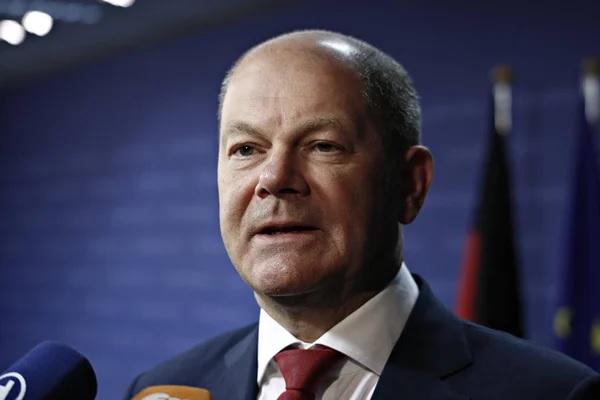
As German Chancellor Olaf Scholz visited the U.S. President Joe Biden at the White House, his first trip to Washington since succeeding Angela Merkel in December, the world seemed to miss the gait, mien and self assuredness it had known with the former Chancellor.
The meeting came as the Biden administration sought to present a united front in its diplomatic deliberations with Russia. Washington has accused Moscow of destabilizing the region by massing troops near its border with Ukraine.
“I think the important message for the administration is that Germany and the United States are on the same page in being prepared to impose major costs, unprecedented costs on Russia, if it commits aggression against Ukraine,” Jeff Rathke, President of the American Institute for Contemporary German Studies at the Johns Hopkins University, told Foreign Policy.
Germany has stood out among major NATO allies for its refusal to arm Ukraine, or allow others to send German-made weapons, in keeping with its overall policy of restraint and more specifically its refusal to export weapons to combat zones.
Scholz’s party, the Social Democrats, have historically seen Russia in a warmer light, which has raised fears in Washington that he may be wary of upsetting his own rank-and-file in an already unprecedented three-party coalition.
Rathke said the meeting wasn’t about the White House needing to win over the new German leader but rather to coordinate positions on what could be a rocky road of sanctions, the impact of which will be more keenly felt in the European Union than the United States. “This is not about treating Germany with kid gloves. It’s about Germany simply being crucial in the particular crisis that the White House is having to deal with right now,” Rathke said.
For weeks, concern has ricocheted around Washington that Germany might undermine the West’s strong stance toward Russia over Moscow’s military build up that threatens Ukraine.
But Biden said there’s no doubt about the steadfastness of the government in Berlin after meeting Scholz. He also promised that the Nord Stream 2 pipeline project bringing Russian gas to Western Europe — a major German priority — would abruptly be shut down in the event that Moscow’s tanks rumble across the Ukrainian border.
“Germany is completely reliable. Completely, totally, thoroughly reliable. I have no doubt about Germany,” Biden said with Scholz at his side in the White House.
Germany’s sensitivity to military operations of any kind beyond its border, given its history of militarism and the complications of its tortured relationship with Russia, mean it’s unlikely to be in the forefront of the Western effort to deter an invasion. But Biden’s comments seem to be a sign of confidence that Scholz is on board for the most punishing sanctions yet on the Russian government if it goes ahead and invades Ukraine — even those that would cause real pain to the German economy.
Still, Scholz left himself some room for maneuver. He was far less equivocal than Biden on shutting down Nord Stream 2.
“We are acting together, we are absolutely united and we won’t be taking different steps,” Scholz said


Further Credits:
Foreign Policy
CNN


