Squeezing The Rich 1,000 Year History Of Zazzau Into A Two Century Window Of Fulani Emirate Rule. ‘Harvest The Fruit, Deny The Roots’


The Oasis Reporters
October 11, 2026


By Aliyu Ammani
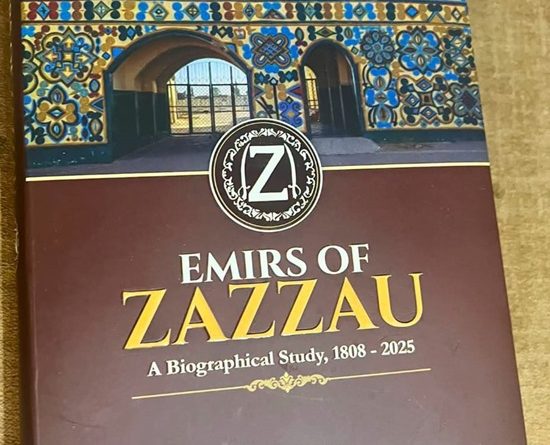
The recent launch of “Emirs of Zazzau: A Biographical Study, 1808–2025” in Zaria was celebrated with grand fanfare. Attended by eminent traditional rulers, state governors, and top dignitaries, the event was billed as a landmark contribution to Northern Nigerian history. Yet beneath the pageantry lies a quiet, troubling omission.

By restricting its biographical scope exclusively to the nineteen Fulani emirs who have occupied the throne since the 1804 Sokoto Jihad, the volume participates in an ONGOING PRACTICE OF HISTORICAL ERASURE. It advances a false premise: that the history of Zazzau began only two centuries ago.
To chronicle the leadership of an ancient kingdom while ignoring sixty pre-Jihad Sarakuna is not mere editorial preference or innocent academic periodisation. It is an ACT OF HISTORICAL TRUNCATION. IT REINFORCES A LONG-STANDING TREND THAT SYSTEMATICALLY MARGINALISES THE PRE-JIHAD HAUSA (the so-called Habe) LEGACY FROM PUBLIC CONSCIOUSNESS, INSTITUTIONAL MEMORY, AND OFFICIAL PALACE RECORDS.
Long before the flag-bearers of Shehu Usmanu Danfodiyo arrived in Zaria, Zazzau was already a regional powerhouse. It was built and expanded by sixty recorded kings and queens whose political vision laid the foundations of the state. From Gunguma in the early eleventh century to Bakwa Turunku, who relocated the capital to Zaria, the kingdom’s political identity was forged by Hausa statecraft.
It was Queen Amina who extended Zazzau’s dominance across the West African savanna, constructing the legendary ‘Ganuwar Amina’ that defended the realm for centuries.
Moreover, the administrative and chieftaincy structures that define the Emirate Council today, including the titles of Sarkin Fada, Galadima, Madaki, Iya, and Makama, were not created after 1804. They were invented, perfected, and institutionalized by the Hausa monarchy.
To publish an official history of Zazzau’s rulers that begins in 1808 is to harvest the fruit of a grand tree while denying the existence of its roots.
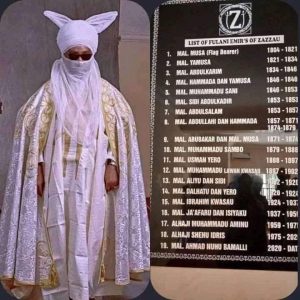
When visitors enter the Emir’s palace in Zaria and see a public display listing only nineteen rulers, or when state-backed volumes document only two centuries of leadership, a subtle message is conveyed: that Zazzau had no worthy governance, no order, and no meaningful civilizational achievement before the nineteenth century.
This selective memory contrasts sharply with other historic polities in Northern Nigeria. Consider the Borno Empire. When Shehu Muhammad al-Amin al-Kanemi and his line assumed leadership in the early nineteenth century, replacing the ancient Seifawa dynasty, the state did not erase its previous millennium of history. To this day, Borno’s identity remains proudly rooted in both the Mais of the Seifawa dynasty and the Shehus of the Kanemi line. Borno understood that dynastic change does not invalidate historical continuity.
Why, then, must Zazzau’s official historiography treat the 1808 transition as Year Zero? Why is the forced exile of the 60th Hausa ruler, Sultan Muhammadu Makau, to found the Zazzau Abuja Kingdom (modern-day Zazzau Suleja) treated as the abrupt end of Hausa participation in Zazzau’s story, rather than as a vital chapter of its continuing legacy?
When official institutions consistently finance, commission, and endorse books that document only the post-Jihad era, it lends weight to the concern that PRE-JIHAD HAUSA HISTORY IS BEING SYSTEMATICALLY TARGETED FOR ELIMINATION.
History must never be written merely to serve dynastic convenience or present political legitimacy. Ruling houses may change, but the heritage of the land belongs to all its people. We must demand greater intellectual integrity from our historians, traditional councils, and cultural institutions.
THE RICH, THOUSAND-YEAR HISTORY OF ZAZZAU CANNOT BE SQUEEZED INTO A TWO-CENTURY WINDOW. It is time to commission and publish a truly comprehensive chronicle of Zazzau — one that honours all seventy-nine monarchs, from Gunguma and Queen Amina to Malam Musa and Ahmed Nuhu Bamalli.
Only by documenting the Hausa Sarakuna and the Fulani Emirs side by side can we restore integrity to the historical record and give full honour to the ancient kingdom of Zazzau.
Aliyu Ammani writes from
U/Shanu, Kaduna


