‘The Published Results Are Difficult To Believe’, Chilean President Gabriel Boric Speaks On Venezuelan Election


The Oasis Reporters
July 30, 2024


US Secretary of State, Antony Blinken has voiced serious concerns about the Venezuelan election.

Watch:
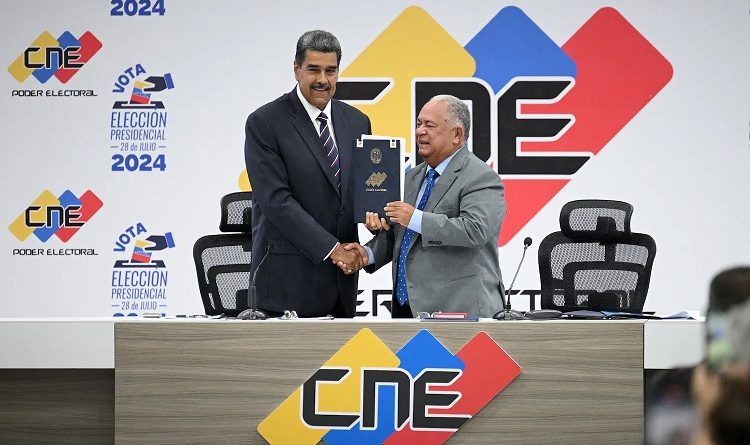
Venezuela’s government-controlled National Electoral Council declared on Monday that incumbent President Nicolás Maduro won a third term in Sunday’s presidential election. With 80 percent of voting stations counted, the country’s election commission claimed that Maduro received 51 percent of the vote, whereas main opposition candidate Edmundo González secured just 44 percent.
The Venezuelan fear driven dictator Nicolás Maduro, who very likely won reelection through fraud, is declaring war on Elon Musk, whom he calls his “arch-enemy.” He claims Elon Musk wants to invade Venezuela with his space rockets.
Opposition leaders and other nations, however, have denounced the results as “impossible” and likely false. “We won, and the whole world knows it,” popular opposition icon María Corina Machado told reporters in the capital, Caracas, on Monday.
Machado—who was set to run against Maduro before Venezuela’s highest court barred her from running in January—asserted that González won 70 percent of the vote compared to Maduro’s 30 percent.
There are “serious concerns that the result announced does not reflect the will or the votes of the Venezuelan people,” U.S. Secretary of State Antony Blinken said on Monday.
Many Latin American countries took similar stances, with Chilean President Gabriel Boric posting on X that
https://x.com/GabrielBoric/status/1817781484692123749
“The Maduro regime must understand that the results it publishes are difficult to believe. The international community and especially the Venezuelan people, including the millions of Venezuelans in exile, demand total transparency of the minutes and the process, and that international observers not committed to the government account for the veracity of the results.
From Chile we will not recognize any result that is not verifiable”, translated from Spanish by Google.
Locals reported voting irregularities across Venezuela on Sunday. Officials at multiple polling places—including at one of the largest voting stations in the capital, where around 15,000 people were eligible to vote—refused to release printouts verifying the National Electoral Council’s digital count. Authorities with the election council delayed releasing the results for six hours without a clear reason as to why. And incidents of intimidation were recorded at several polling stations, with individuals blocking access to voting centers and some Venezuelans being attacked while waiting in line.
Ahead of the election, the Maduro government also took actions seen as intended to skew the vote in his favor, including arresting members of the Machado-González campaign and imposing strict voting restrictions on Venezuelans living abroad.
This is not the first time that Maduro’s regime has been suspected of tampering with an election. A software company involved in voting on the country’s 2017 constitutional referendum accused Maduro’s administration of altering at least 1 million votes to declare its passage. And on Monday, Maduro accused unidentified foreign entities (without evidence) of once again trying to hack the nation’s voting system.
If Maduro were to relinquish control, he could end up in prison.
The United States has indicted Maduro on drug trafficking and terrorism charges, and the International Criminal Court is investigating his regime for crimes against humanity.
Instability in Venezuela could also worsen depending on if (and how) Maduro decides to crack down on the opposition.
Since Maduro first took office in 2013, oil prices have plummeted, basic goods have faced widespread shortages, inflation has risen by 130,000 percent, and nearly 8 million Venezuelans have fled the country.
Last October, the Biden administration lifted several sanctions on Venezuela but then reimposed some of them after Maduro banned Machado from running.
It is unclear how Washington will respond to Maduro’s latest effort to maintain power.
“We’re watching, the world’s watching,” U.S. National Security Council spokesperson John Kirby told reporters on Monday. But he added: “We’re going to hold our judgment until we see the actual tabulation of the results.”
Additional reporting: Foreign Policy


