
Tiny Rich Brunei To Start Stoning Adulterers This Week With Sharia Law


The Oasis Reporters
March 3, 2019

The world woke up to the news that one of the 5 topmost rich countries in the world, the tiny rich sultanate of Brunei would shortly begin to stone adulterers to death and punish some other crimes by execution including robbery, in full and strict implementation of Sharia law.
The new penal code which includes death by stoning for gay sex and adultery, were due to come into force on Wednesday.
The tough penal code in the tiny country on tropical Borneo island — ruled by the all-powerful Sultan Hassanal Bolkiah — is set to be fully implemented following years of delays.
The laws, which also include amputation of hands and feet for thieves, will make Brunei the first place in East or Southeast Asia to have a sharia penal code at the national level, joining several mostly Middle Eastern countries such as Saudi Arabia.


Rape and robbery are also punishable by death under the code and many of the new laws, such as capital punishment for insulting the Prophet Mohammed, apply to non-Muslims as well as Muslims.

The decision to push ahead with the punishments has sparked alarm around the world, with the United Nations labelling them “cruel and inhumane” and celebrities, led by actor George Clooney and pop star Elton John, calling for Brunei-owned hotels to be boycotted.

Brunei is a commonwealth country. The British International Development Minister, Penny Mordaunt has expressed strong reservations on the new development, and The Oasis Reporters watched a RebelTV reporter, of Canada, Janice Atkinson who was given the cold shoulder at the front of the Brunei High Commission in London that neither opened the door for her nor assist her in answering questions through the door speaker. She was eventually cut off.

The UK’s international development secretary, Penny Mordaunt, said: “Brunei’s decision is barbaric and the UK stands with the LGBT community and those who defend their rights. LGBT rights are human rights.” pic.twitter.com/H2yET20yDK
— Eddie Du (@Edourdoo) March 28, 2019
It is 2019 and today #Brunei introduces death by stoning as punishment for homosexuality. Our Government must not only condemn, as @PennyMordaunt has done, but work to ensure the safety of #LGBT in the region. https://t.co/ese5OzCeUS
— Matthew Hodson (@Matthew_Hodson) April 3, 2019

Brunei is a country in Asia and it’s
Capital city is Bander Seri Begawan.
The head of state is Sultan Hassanal Bolkiah with a population of 423,000.
Size 5,765 square kilometres (2,226 square miles)
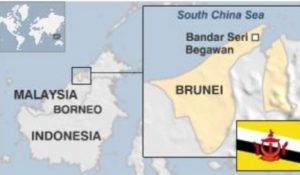
The tiny state of Brunei has one of the world’s highest standards of living thanks to its bountiful oil and gas reserves.
Its ruling royals, led by the head of state Sultan Hassanal Bolkiah, possess a huge private fortune and its largely ethnic-Malay population enjoy generous state handouts and pay no taxes.
A British protectorate since 1888, Brunei was the only Malay state in 1963 which chose to remain so rather than join the federation that became Malaysia. Full independence came relatively late in 1984.
Despite a significant non-Muslim minority presence in the country and strong condemnation from international rights group, in 2014 Brunei became the first East Asian country to adopt strict Islamic sharia law which allows punishment such as stoning for adultery and amputation for theft.
In the country with 65% ethnic Malay, 10% Chinese, 78% Muslim, 8% Christian, 7% Buddhist, they speak Malay, English, Chinese.
It has a life expectancy of 75 years (men), 79 years (women), at a time it is dropping to below 50 in another oil producing country, Nigeria.
The Sultan of Brunei, Hassanal Bolkiah, is one of the world’s longest-reigning and few remaining absolute monarchs. He was crowned in August 1968 following the abdication of his father, Sir Haji Omar Ali Saifuddin.
Upon Brunei’s independence in 1984, he appointed himself prime minister and in 1991, introduced an ideology called Malay Muslim Monarchy, which presented the monarch as the defender of the faith.
He is one of the world’s richest individuals and in a country where the standard of living is high, appears to enjoy genuine popularity amongst his subjects. More recently however, he has faced criticism over the introduction of Islamic Sharia law in the country.
Sultan Hassanal Bolkiah says he wants the Muslim call to prayer to ring out in all public places.
Brunei’s media are neither diverse nor free. The private press is either owned or controlled by the royal family. Broadcasting is dominated by state radio and TV.
Media workers exercise self-censorship when covering politics and religion.
In a public address to mark a special date in the Islamic calendar, the sultan called for stronger Islamic teachings but did not mention the new penal code.
“I want to see Islamic teachings in this country grow stronger,” he said in the nationally televised speech at a convention centre near the capital Bandar Seri Begawan.
“I would like to emphasize that the country of Brunei is a… country that always devotes its worship to Allah.”
He said that he wanted the Muslim call to prayer to ring out in all public places, not just in mosques, to remind people of their Islamic duties.
The sultan, who has been on the throne for over five decades, also insisted that Brunei was a “fair and happy” country.
“Anyone who comes to visit this country will have a sweet experience, and enjoy the safe and harmonious environment,” he said.
Officials did not immediately confirm that the sharia penal code had entered into force. At the weekend, the Brunei government said in a statement that the new punishments would be enforced from Wednesday.
The tough punishments have triggered worldwide condemnation.
Phil Robertson, deputy Asia director at Human Rights Watch, said the code was “barbaric to the core, imposing archaic punishments for acts that shouldn’t even be crimes”.
The sultan — who is one of the world’s wealthiest men and lives in a vast, golden-domed palace — announced plans for the code in 2013.
The new laws make sex between men punishable by death by stoning. For women convicted of having sexual relations with other women, the maximum punishment is 40 strokes of the cane or a maximum 10-year jail term.
The first section of the code was introduced in 2014 and included less stringent penalties, such as fines or jail terms for offences including indecent behaviour or skipping Friday prayers.
Clooney’s call to boycott nine Brunei-owned hotels in Europe and the United States last week catapulted the issue into the international headlines.
Since then, a series of well-known figures have lined up to add their names to the chorus of condemnation, including former US vice president Joe Biden and actress Jamie Lee Curtis.
Governments have weighed in, with the United States saying the punishments run counter to Brunei’s “international human rights obligations”.
“The United States strongly opposes violence, criminalisation and discrimination targeting vulnerable groups,” said deputy State Department spokesman Roberto Palladino.
The sultan, who is the world’s second-longest reigning monarch, first called for the penal code in the late 1990s and it appears to enjoy broad support but analysts say he is seeking to burnish his Islamic credentials and shore up support among the country’s conservatives due to the waning fortunes of the oil-dependent economy, which has been ravaged by recession in recent years.
It is also unclear whether death by stoning will actually be implemented, as a high burden of proof is needed to hand down the punishment and Brunei has not executed anyone for decades.
Agence France-Presse
BBC
Rebel TV, Canada
The Guardian
Reuters
UN factfile
NDTV


