
Lula’s Corruption Lap As Brazil Speaks Jail To It’s Best President Ever


The Oasis Reporters
July 14, 2017
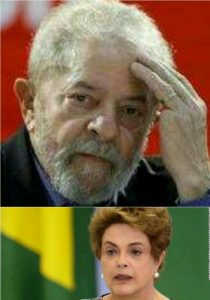
Dilma Roussef, bottom
Brazil now has the utmost liberty to call to question it’s President and wastes no time in disciplining them the hard way because it has zero tolerance for corruption in public life.
Really it should be so.
It wasn’t so in the beginning under a series of dictatorships in the past.
These are the days of democracy, probity and inquisition into the past.
Talk about a president that has served the people of Brazil with all his heart, it was Luiz Inácio Lula da Silva.


Despite his sterling credentials, former President of Brazil, Luiz Inácio Lula da Silva, was detained as part of corruption investigations.
Lula’s administration was plagued by corruption scandals, most notably the mensalão and sanguessugas scandals, in his first term. Although the independent office of the Brazilian Attorney-General presented charges against 40 politicians and officials involved in the Mensalão affair, several charges were presented against Lula himself.
He has now been sent to jail but remains free pending his appeal.
Lula has called it a politically motivated trial designed to stall his re-entry into the presidential contest for an unprecedented third term, though not consecutive.

This is happening several months after impeaching It’s second best president , Dilma Roussef.

Luiz Inácio Lula da Silva was born 27 October 1945, known simply as Lula, he is a Brazilian politician who served as President of Brazil from 1 January 2003 to 1 January 2011.
A founding member of the Workers’ Party (PT) ran for president three times unsuccessfully, first in 1989 election, then again in 1994 and 1998.
Victory came in the 2002 election, and was inaugurated as president on 1 January 2003. In the 2006 election he was elected for a second term as president, which ended on 31 December 2010 as the 35th president of the Portuguese speaking Latin American nation.

Succeeded by his former Chief of Staff, Dilma Rousseff, he left an enduring mark on Brazilian politics in the form of Lulism.
His education was at National Service for Industrial Training and he worked as a Metalworker and trade unionist.
He is often regarded as one of the most popular politicians in the history of Brazil and, at the time of his tenure, one of the most popular in the world.
Social programs like Bolsa Família and Fome Zero are hallmarks of his time in office. Lula played a prominent role in recent international relations developments, including the nuclear program of Iran and global warming, and was described as “a man with audacious ambitions to alter the balance of power among nations.”. He was featured in Time’s The 100 Most Influential People in the World for 2010,[9] and Perry Anderson called him “the most successful politician of his time.”[

On July 12, 2017, the former president was convicted of the crime of passive corruption loosely defined in Brazilian criminal law as the receipt of a bribe by a civil servant or government official) and money laundering and sentenced to nine years and six months in prison by judge Sérgio Moro.
A man of humble beginnings Lula had little formal education. He did not learn to read until he was ten years old, and quit school after the second grade in order to work to help his family.
At age 12, he worked as a shoeshiner and street vendor. Two years later, he got his first formal job in a plutonium processing factory as a lathe operator.
At age 19, he lost the little finger on his left hand in an accident while working as a press operator in an automobile parts factory and
ran to several hospitals before he received medical attention. This experience increased his interest in participating within the Workers’ Union. Around that time, he became involved in union activities and held several important union posts.
He rose steadily in the ranks of Trade Unionism, and became president of the Steel Workers’ Union of São Bernardo do Campo and Diadema in 1975.
In the late 1970s, when Brazil was under military rule, Lula helped organize union activities, including major strikes. Labour courts found the strikes to be illegal, and Lula was jailed for a month. Due to this, and like other people imprisoned for political activities under the military government, Lula was awarded a lifetime pension after the regime fell.
In 1983 he helped found the Central Única dos Trabalhadores (CUT) union association. In 1984 PT and Lula joined the popular Diretas Já! (Direct [Elections] Now!) campaign, demanding a ‘Change’ to direct popular vote for the next Brazilian presidential election. According to the 1967 constitution, Presidents were at that time elected by both Houses of Congress in joint session, with representatives of all State Legislatures; which was widely recognised as a mere sham as, since the March 1964 coup d’état, each “elected” President had been a retired general chosen in a closed military caucus. Lula and the PT supported the public demand for a change in the electoral system.
Only four years later, as a direct result of Diretas Já! and after years of popular struggle, the 1989 elections were the first in 29 years to elect a president by direct popular vote.
Lula started the Brazilian Social Assistance in the form of subsidized housing and Bolsa Família credits.
Lula put social programs at the top of his agenda during the campaigns and after election.
His leading program was to eradicate hunger, following the lead of projects already put into practice by the Fernando Henrique Cardoso administration, but expanded by the new Fome Zero (“Zero Hunger”) program.
His programs included bringing together ideas to end hunger in Brazil, including the construction of water cisterns in Brazil’s semi-arid region of Sertão, plus actions to counter teenage pregnancy, to strengthen family agriculture, to distribute a minimum amount of cash to the poor, and many other measures.
The largest assistance program, however, was Bolsa Família (“Family Allowance”), like the previous Bolsa Escola (“School Allowance”), conditional on school attendance.
It later became a federal program in 2001.
In 2003, Lula created a new ministry – the Ministry of Social Development and Eradication of Hunger and also formed Bolsa Família by combining Bolsa Escola with additional allowances for food and kitchen gas. This merger reduced administrative costs and bureaucratic complexity for both the families involved and the administration of the program.
Fome Zero has a government budget and accepts donations from the private sector and international organizations. The Bolsa Família program has been praised internationally for its achievements, despite internal criticism accusing it of having turned into an electoral weapon.
Along with projects such as Fome Zero and Bolsa Família, the Lula administration’s flagship program was the Growth Acceleration Program (PAC). The PAC had a total budget of $646 billion reais (US$353 billion) by 2010, and was the Lula administration’s main investment program. It was intended to strengthen Brazil’s infrastructure, and consequently to stimulate the private sector and create more jobs. The social and urban infrastructure sector was scheduled to receive $84.2 billion reais (US$46 billion).
His government achieved a satisfactory primary budget surplus in his first two years, as required by the IMF agreement, exceeding the target for the third year. In late 2005, the government paid off its debt to the IMF in full, two years ahead of schedule.
Three years after the election, Lula had slowly but firmly gained the market’s confidence, and sovereign risk indexes fell to around 250 points, inflation targeting kept the economy stable, and was complimented during the 2005 World Economic Forum in Davos.
Lula steered Brazil after decades as the largest foreign debtor among emerging economies to becoming a net creditor for the first time in January 2008.
By mid-2008, both Fitch Ratings and Standard & Poor’s had elevated the classification of Brazilian debt from speculative to investment grade. Banks made record profits under Lula’s government.
Lula became the darling of all, as the first president to bring a modest well-being to many people, but also in complete control of his own administration.
The crash of Wall Street in 2008 was in Brazil no more than a little ‘ripple’ (“uma marolinha”). Brazil enjoyed economic good health to fight the global financial crisis with large stimulus packages lasting, until 2014.
The Lula Administration’s economic policies also helped to significantly raise living standards, with the percentage of Brazilians belonging to the consumerist middle class rising from 37% to 50% of the population.
“Under Lula, Brazil became the world’s eighth-largest economy, more than 20 million people rose out of acute poverty and Rio de Janeiro was awarded the 2016 Summer Olympics, the first time the Games will be held in South America” , according to The Washington Post, October 2010 in it’s main article: Foreign relations of Brazil
During the Lula administration, Brazilian foreign trade increased dramatically, changing from deficits to several surpluses after 2003. In 2004 the surplus was US$29 billion, due to a substantial increase in global demand for commodities. Brazil also provided UN peace-keeping troops and led a peace-keeping mission in Haiti.
According to The Economist of 2 March 2006, Lula had a pragmatic foreign policy, seeing himself as a negotiator, not an ideologue, a leader adept at reconciling opposites. As a result, he befriended both Venezuelan president Hugo Chávez and U.S. President George W. Bush.
Rated as the most popular Brazilian president of all time with an 80.5% approval rate in his last months as the president, then US president Barack Obama greeted Lula at the G20 summit in London (April 2009) with the words, “That’s my man right there…love this guy…The most popular politician on earth.”
Having lost numerous government aides in the face of political turmoil, Lula survived largely unscathed in the eyes of the public, with overwhelming approval rates.
His predecessor in office, Dilma Roussef was herself impeached from office in her second term. She too had an exceptional presidency, but the declining economy did her in more than anything else.


