Xenophobia In South Africa: State’s Complicity With Gangs And Vigilantes Is Threatening Its Ability To Govern


The Oasis Reporters
June 17, 2026


Loren B Landau, University of the Witwatersrand and Jean Pierre Misago, University of the Witwatersrand
Marches, Mozambicans murdered, state-sponsored evacuations, a nationally televised presidential address. Anti-immigrant mobilisation has again drawn the world’s attention to South Africa. The continental backlash threatens tourism, trade, diplomacy and investment opportunities in Africa’s largest economy, and is derailing its constitutional democracy.
Many citizens demand the country restore its sovereignty – the state’s ability to govern itself and determine its own laws within its borders – by tightening border controls. Parties promise to deliver walls, raids and deportations.
What these popular debates over sovereignty and border control overlook is that politics is not defined on the borders. It comes from control over resources and production. In South Africa’s past, this was mines. Now it is cities, townships, and the infrastructure that connects them. This is where the country’s political future is being forged. This is where sovereignty is being lost. And the state is helping to make this happen.

Over the past 20 years, we have investigated the politics of migration and xenophobia in South Africa. Together we founded Xenowatch and the Mobility Governance Lab to document incidents of xenophobic discrimination and evaluate strategies to promote secure mobility and social cohesion.
In a paper published in 2022 we argued that xenophobic mobilisation in South Africa was not merely a grassroots phenomenon by frustrated communities. Nor is it the result of a “third force” or external actors out to embarrass the country. Rather, we argue, it is a political enterprise co-produced by vigilante groups and the state through acts of commission and omission. These include failing to censure those who exclude through violence and other forms of illegal conduct. It also includes migration policies and practices that demonise those from other countries.
This has resulted in the state consistently legitimising and rewarding the criminal conduct of vigilante groups.
Our research shows that xenophobic discrimination has become a feature of post-apartheid South Africa’s socio-political landscape. We argue that the only interventions capable of disrupting xenophobic mobilisation are those that lower, or ideally eliminate, its political, economic and social benefits. This must include holding people accountable for their actions, consistent and impartial application of the law to address both illegal migration and criminal vigilante exclusion of migrants, and joint efforts by the state and civil society to counter anti-migrant mobilisation.
On the ground
Our investigations show that in townships, “community development” associations run protection rackets determining who can live, build, or conduct business in their “communities”. They work in collaboration with local police to remove unwanted people.
Elected leaders often look away or embrace them to win votes. This is not about enforcing law or creating opportunities for all. It is not about immigration control. It is about using social division to extract resources and build power. There is often strong local support for these measures and those leading them. However, they are illegal and institutionalise state complicity in extractive violence that weakens, rather than enforces, the rule of law.
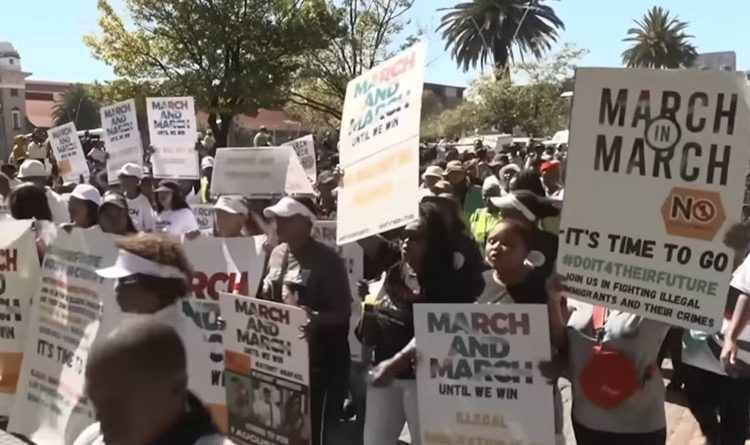
From mid-2025, Operation Dudula – an anti-immigrant social movement that has now registered as a political party – and March and March – a self-described “grassroots” civic organisation focused on illegal immigration – systematically blockaded public health facilities, denying migrants access to at least 53 clinics across KwaZulu-Natal, Limpopo, Mpumalanga and Gauteng provinces.
The South African Human Rights Commission found that despite engagement with the Department of Health and the National Commissioner of Police (both of which committed to intervening) vigilante conduct continued. In some instances the police refused to take statements from victims.
Despite court rulings interdicting Operation Dudula, the unlawful operations continued across the country.
Without state enforcement, court orders are only paper. Rather than being sanctioned, March and March confirmed that it had
an agreement with the SAPS (South African Police Service) and Metro Police, which don’t interfere with them.
A co-authored political enterprise
Between 2022 and 2025, Xenowatch recorded 406 verified incidents resulting in 75 deaths. This translates into an average of 102 xenophobic discrimination incidents per year.
In 2025 alone, 151 incidents were recorded. In the first five months of 2026, a further 22 verified incidents were recorded. Of the 22 incidents, 14 were violent attacks that largely followed anti-migrant protests in some parts of the country.
The recent attacks resulted in at least four people dead and hundreds displaced. Despite this, officials regularly argue this is “normal” criminality. In 2008, 2010, and again in 2026, there have been accusations of a third force determined to undermine the country’s successes or punish it for its positions on Israel and Russia.
Rather than intervene effectively, the government has addressed the rise of these political formations with a National Action Plan on Racism and Xenophobia. It contains almost no plan. Rather than marshal state resources against the anti-immigrant campaigns, it focuses on education and public events intended to foster goodwill and social cohesion. Debates and dialogues are welcome. But they do little to erode the power of gangsters and criminal networks.
When the state has acted, it helps reinforce precisely the kind of political fragmentation and profit taking it purports to prevent. Its largest police operation to protect foreigners – Operation Fiela – resulted in police demanding additional bribes from migrants, a loss of economic activity and tax revenue, and only a small reduction in immigrant numbers.
All this was done in the name of restoring citizens’ faith in the immigration system. There were winners: not immigrants or citizens, but law enforcers who line their pockets and boost their operational budgets.
A recent meeting convened at the official seat of government, the Union Buildings, provides another example. On 25 May 2026, senior government ministers convened a high-level meeting with the leadership of March and March and other organisations “to address illegal immigration and the rise in anti-immigration protests in the country”.
In our view, granting groups like this access to the highest political office lends them legitimacy and gives them a place in the South African political system. Their words are broadcast on national television and radio stations. Their ultimatums come to represent legitimate political demands.
The state may temporarily quell crises. But it emboldens these groups to carry on. The results are a politics of fragmentation and self-made laws.
What needs to be done
Protecting South Africa’s constitutional democracy requires three things done simultaneously.
First, genuine accountability for perpetrators: not symbolic arrests, but prosecutions that result in meaningful consequences for instigators and perpetrators.
Second, consistent and impartial enforcement of the rule of law to address both illegal migration and criminal vigilante exclusion of migrants.
Third, the building of political will and muscle by the state and civil society, to hold politicians accountable when their rhetoric or conduct emboldens exclusionary violence and practices. This is not an issue of migration management and border control. It is one of sovereignty and law.
Civil society organisations are already pursuing litigation and winning cases in court. But court orders flouted with impunity are not victories; they are further evidence of the problem. Without the political muscle to hold the state accountable for its complicity, the co-creation of exclusion will continue.
Loren B Landau, Co-Director of the Wits-Oxford Mobility Governance Lab, University of the Witwatersrand and Jean Pierre Misago, Researcher, University of the Witwatersrand
This article is republished from The Conversation under a Creative Commons license. Read the original article.


